
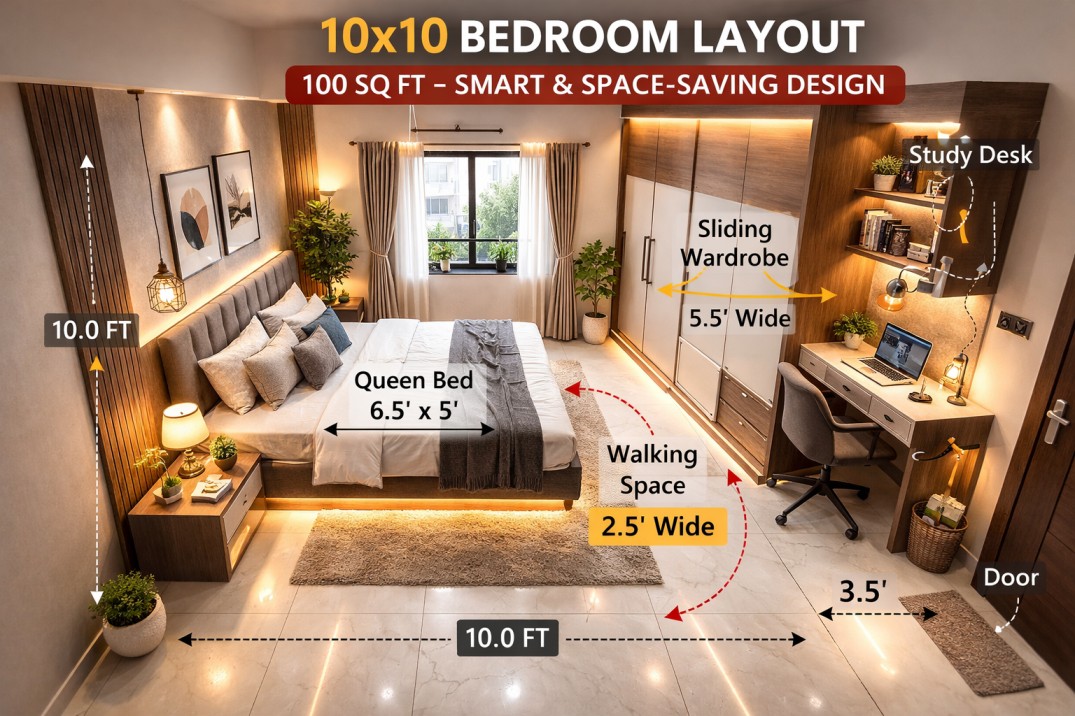
What You’ll Learn in This Guide
– 12 tested floor plans with exact measurements
– Which bed size actually fits (queen vs double vs single)
– Sliding vs hinged wardrobe — which saves more space
– Minimum walking space rules most people ignore
– Budget breakdown from ₹15,000 to ₹1,50,000
– Vastu tips for 10×10 bedroom
– 10 FAQs — AC placement, attached bathroom, dressing table
A 10×10 bedroom feels small on paper — 100 square feet, four walls, and suddenly you have to fit a bed, a wardrobe, maybe a desk, and still be able to walk around without bumping into things.
The truth? of 10×10 bedroom layout Most people make it harder than it needs to be. They either cram too much furniture in, or they under-use the space and end up with a room that feels empty but still messy.
I’ve gone through every layout combination that actually works in a 10×10 room — not Pinterest fantasy rooms, but real floors plans with real measurements that you can follow. In this guide, you’ll get:
- 12 tested 10×10 bedroom layout floor plans with exact measurements
- Bed size comparison table — what fits and what doesn’t in Indian context
- Wardrobe placement guide — sliding vs hinged, which wall, why it matters
- Walking space rules — the one thing everyone ignores and regrets later
- Budget breakdown from ₹15,000 to ₹1,00,000+
- 10 FAQs covering AC placement, false ceiling, vastu, dressing table — all answered
Whether you’re designing a 1BHK master bedroom, a kids’ room, or a guest room — pick the layout that matches your situation and follow the measurements.
If you also want styling and decoration ideas after planning the layout, you can read this small bedroom decor guide which explains how to visually make compact rooms look bigger.
Understanding Your 10×10 Room: What You’re Really Working With
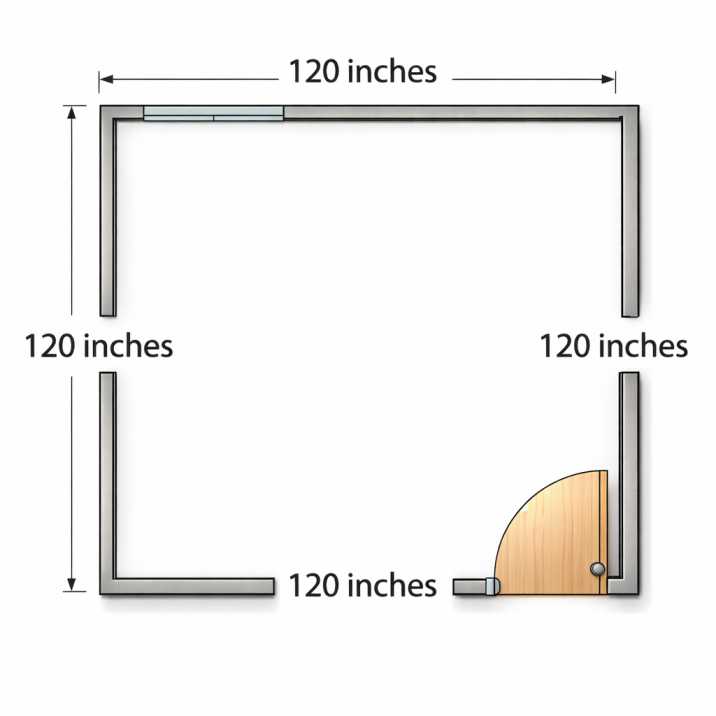
10×10 feet = 120 inches × 120 inches = 100 square feet. That’s the math. But the usable space is always less.
In most Indian builder apartments, the carpet area of a 10×10 room is roughly 9.5×9.5 feet after accounting for wall thickness (typically 4–6 inches per wall). That gives you closer to 90 usable square feet. Keep this in mind when placing furniture — the room will always feel 6–8 inches tighter than you expect.
Also account for:
- Door swing — a standard door needs 3 feet of clearance. If your door opens inward, that’s instant floor space lost.
- Window placement — never block a window with a wardrobe or headboard if you can avoid it. Light makes a small room feel bigger.
- AC or fan position — ideally opposite the bed, not directly above it.
Table 1: Standard Furniture Sizes (Indian Market)
| Furniture | Width (inches) | Length (inches) | Notes for 10×10 |
| Single / Twin Bed | 36 | 75 | Maximum floor space saved — ideal for students |
| Double Bed | 54 | 75 | Best balance for couples — most popular in India |
| Queen Bed | 60 | 80 | Fits, but leaves limited clearance on sides |
| King Bed | 76 | 80 | Avoid — leaves barely 22 inches on one side |
| Wardrobe (standard depth) | 22–24 | — | Sliding preferred; saves 30 inches of swing space |
| Compact Study Desk | 18–24 | 36–42 | Fits against wall when single bed is used |
| Bedside Table | 18 | 18 | One fits on most layouts; two only with single/double bed |
Walking Space Rules — The One Thing Everyone Gets Wrong
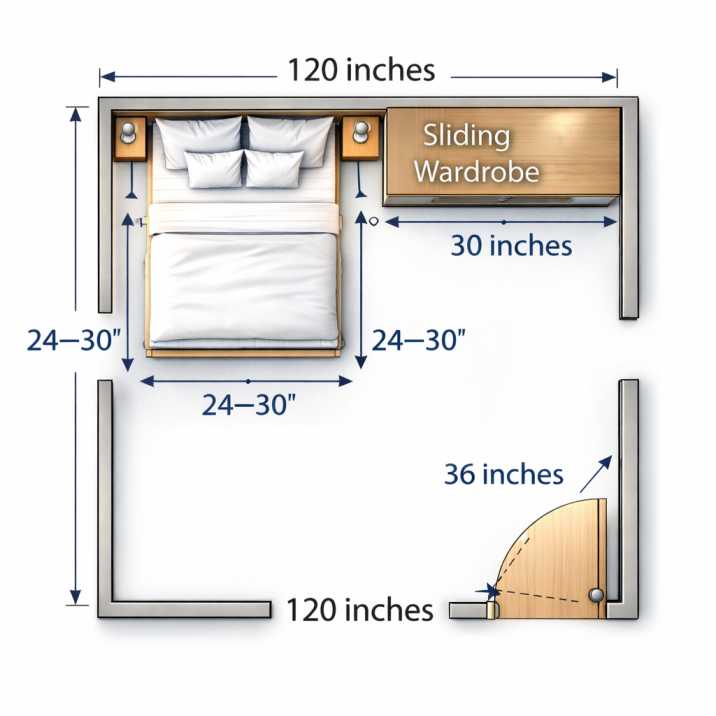
Most bedroom design mistakes happen not because of wrong furniture choice — but because of ignored clearance. You can have the right bed in the right room and still feel cramped if you haven’t left enough walking space.
Note – Most bedroom design mistakes happen not because of wrong furniture choice — but because of ignored clearance.”
Here are the non-negotiable minimums:
Table 2: Clearance Quick Guide
| Space / Area | Minimum (inches) | Comfortable (inches) | Why It Matters |
| Side of bed (one side) | 24 | 30 | You need to make the bed and get in/out easily |
| Foot of bed | 24 | 36 | Walking path to wardrobe or door |
| In front of wardrobe (hinged door) | 30 | 36 | Door must open fully without hitting bed |
| In front of wardrobe (sliding door) | 0 extra | 18 | Slides in-frame — major space saver |
| Study desk chair pullout | 24 | 30 | You need room to sit and stand comfortably |
| Bedroom door clearance | 36 | 42 | Full door swing or at least 90-degree open |
💡 Pro tip: Always walk your layout before buying furniture. Use newspaper sheets (roughly 2×3 ft each) to mark furniture footprints on your actual floor. Stand in each ‘walking path’ and check if it feels tight.
Wardrobe Types and Best Placement for a 10×10 Room
The wardrobe is usually the second-largest piece of furniture in a bedroom — and in a 10×10, the wrong wardrobe type can eat up all your clearance space.
Sliding vs Hinged Wardrobe — Which One to Choose?
In a 10×10 room, sliding wardrobes almost always win. Here’s why:
- A hinged 2-door wardrobe needs 30–36 inches of clearance in front of it just to open fully. In a small room, that’s your entire walking path.
- A sliding wardrobe needs zero extra clearance. Doors slide within the frame. You can place the bed much closer to it.
- Sliding wardrobes in India typically come with a depth of 22–24 inches — enough for hanging clothes, shelves, and a small drawer unit inside.
- One downside: sliding wardrobes don’t give you full width access at once — you can only open half the wardrobe at a time.
Indian Wardrobe Note — Sarees and Traditional Clothing
If the room belongs to someone who wears sarees or heavy Indian outfits, you’ll need a wardrobe with at least one full-length hanging section (minimum 54 inches height). Many standard modular wardrobes have shelves at that height — check before buying. A carpenter-made wardrobe can be customised better for this.
Many small bedroom layouts also work better when the room is kept clutter-free. These minimalist bedroom ideas show how fewer furniture pieces can actually make small rooms feel larger.
Best Wall to Place Wardrobe in a 10×10 Room
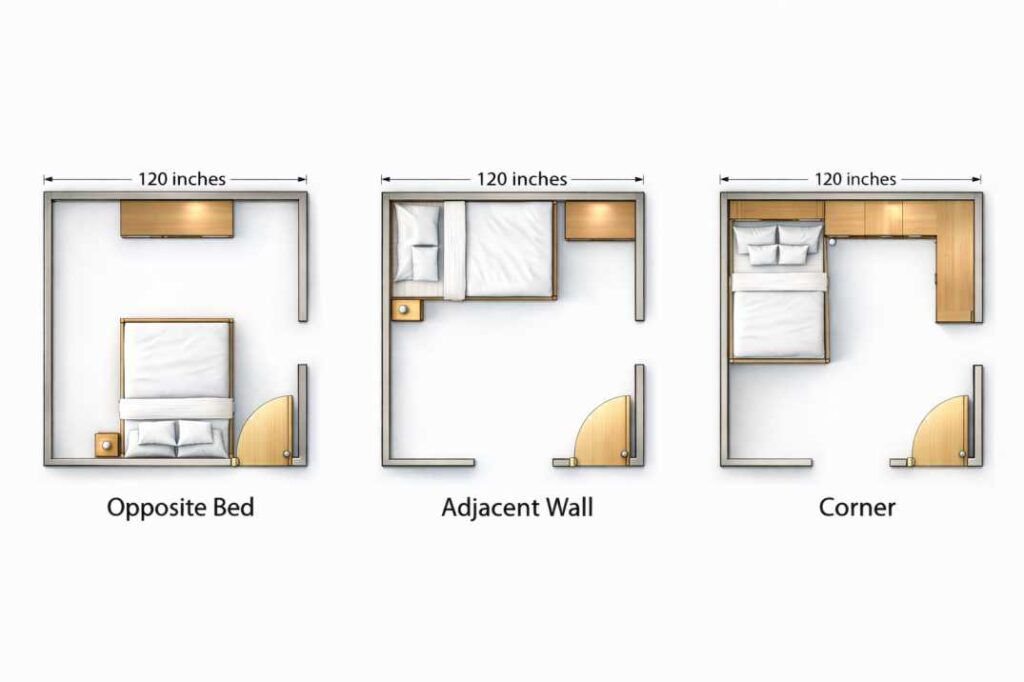
- Opposite the bed (most common) — keeps the bed area clean, wardrobe feels like a feature wall
- Adjacent to the bed (same wall, side) — frees up the facing wall for a desk or TV unit
- Corner placement — works well with L-shaped wardrobes, maximises corner space that’s usually wasted
💡 If you have an attached bathroom door or a balcony door in your room, always plan wardrobe placement after marking both door swings. Attached bath doors often eat into the wall space you were counting on.
12 Smart 10×10 Bedroom Layouts — With Floor Plans and Measurements
Each layout below is designed for a specific situation. Read the ‘Best for’ line first — pick the layout that matches your room and your needs. All measurements assume carpet area of 9.5×9.5 feet (Indian standard after wall thickness).
Layout 1 — Corner Bed Layout
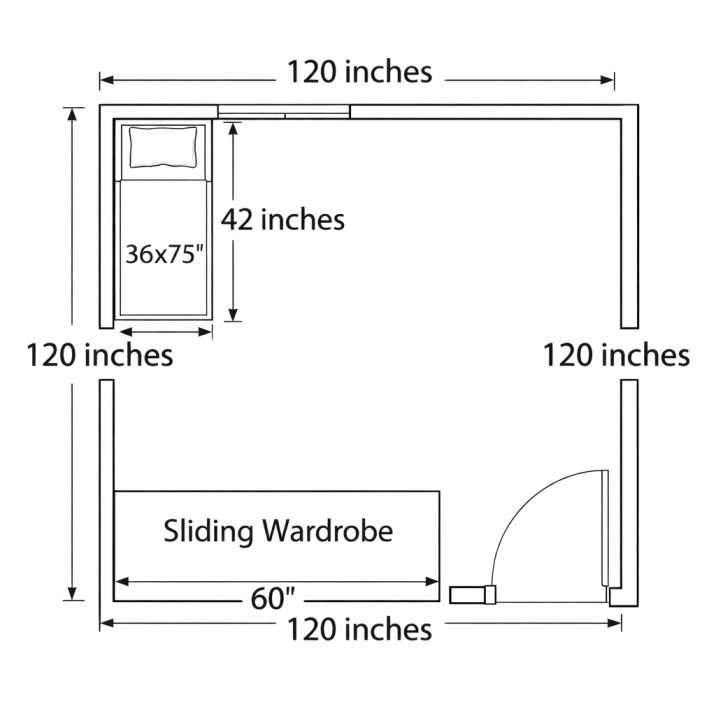
Best for: Single occupant who wants maximum floor space.
In this 10×10 bedroom layout, the single bed sits in the corner with two walls acting as a natural headboard zone. The wardrobe goes on the opposite long wall. This opens up a clear L-shaped walking path from the door to the bed.
- Bed: Single (36×75 inches) — placed in far corner from door
- Wardrobe: 60-inch sliding wardrobe on opposite wall
- Remaining floor space: approx. 42 inches on bed’s open side, 48 inches at foot
- Optional: compact desk (18×36 inches) fits beside wardrobe
- Pros: Maximum open floor, easy cleaning, feels spacious
- Cons: You have to climb over to the wall side of the bed
Layout 2 — Center Wall Bed Layout (Best for Couples)
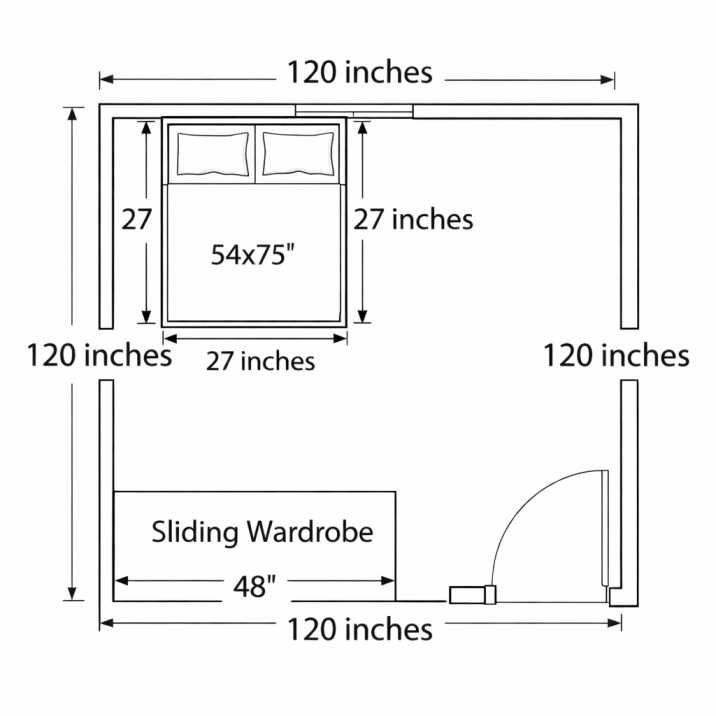
Best for: Couples using a double or queen bed.
The bed is centered on the main wall with the headboard against it. This is the most practical 10×10 bedroom layout for two people — it gives access from both sides of the bed, which matters a lot when two people are getting in and out.
- Bed: Double (54×75 inches) centered on longest wall, headboard against wall
- Clearance: 27 inches on each side of the bed — just enough
- Wardrobe: 48-inch sliding wardrobe on adjacent wall
- No room for a desk in this layout — trade-off for couple comfort
- Pros: Equal access both sides, symmetrical feel, couples prefer this
- Cons: Wardrobe limited to one wall, no desk space
Layout 3 — Bed + Study Desk (Student Layout)
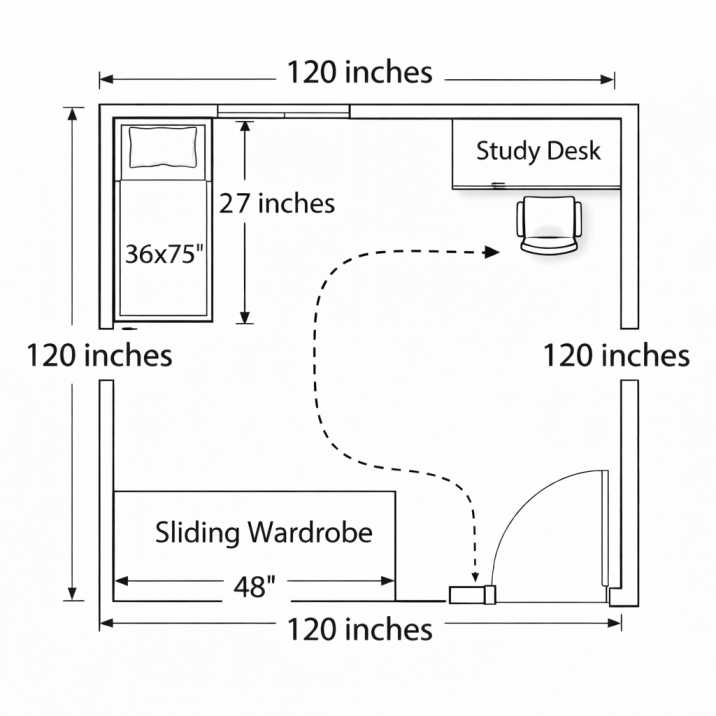
Best for: Students, work-from-home professionals, single occupants.
A single bed goes in the corner. The desk sits on the wall perpendicular to the wardrobe. This gives you a clear zone separation — sleep side and work side — without the two overlapping.
- Bed: Single (36×75 inches) in corner
- Wardrobe: 48-inch sliding on opposite wall
- Desk: 42-inch desk on the third wall, chair pulls out into central space
- Walking path: clear L-shape from door to both zones
- Pros: Functional, three zones in one small room
- Cons: Chair path overlaps slightly with bed foot — keep chair pushed in when not in use
Layout 4 — Sliding Wardrobe Full Wall Layout
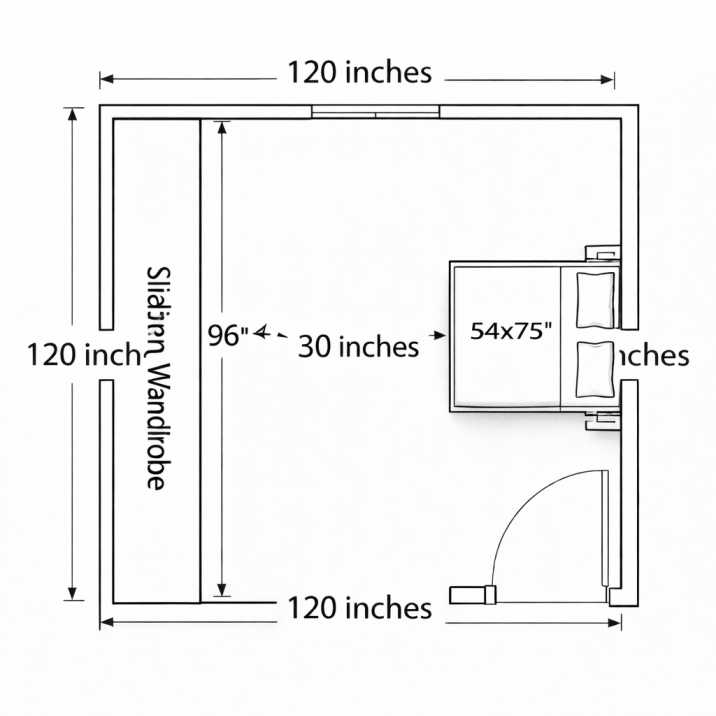
Best for: Anyone who needs serious storage — large families, someone who shares a room but needs their own wardrobe space.
A full 96-inch sliding wardrobe fills one entire wall. The bed is placed opposite or adjacent. This layout sacrifices a little floor feel for massive storage capacity.
- Bed: Double (54×75 inches) opposite the wardrobe wall
- Clearance in front of wardrobe: 30 inches minimum (sliding, so no door swing needed)
- Remaining space at bed sides: approx 21 inches each side — tight but walkable
- Pros: Maximum storage, clean look, wardrobe as feature wall
- Cons: Tighter side clearance on bed — not ideal for elderly
Layout 5 — Two Single Beds (Kids Room / Guest Room)
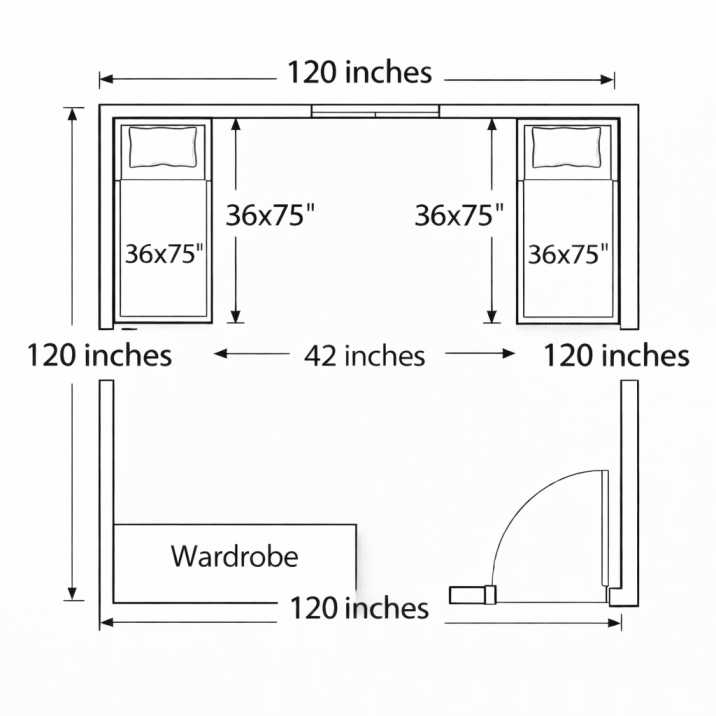
Best for: Two kids sharing a room, guest bedroom with occasional dual use.
Two single beds placed against opposite walls. The centre of the room stays open — which kids actually need (floor play, homework area, stretching). Each person gets their own bedside area.
- Bed 1: Single (36×75 inches) against left wall
- Bed 2: Single (36×75 inches) against right wall
- Centre clearance: 42 inches — works as play zone or study zone
- Wardrobe: placed at foot of one bed on the end wall
- Pros: Privacy for each occupant, open centre is versatile
- Cons: Wardrobe options limited — one compact unit or two small ones
Layout 6 — Murphy Bed / Wall Bed Layout (Multi-Use Room)
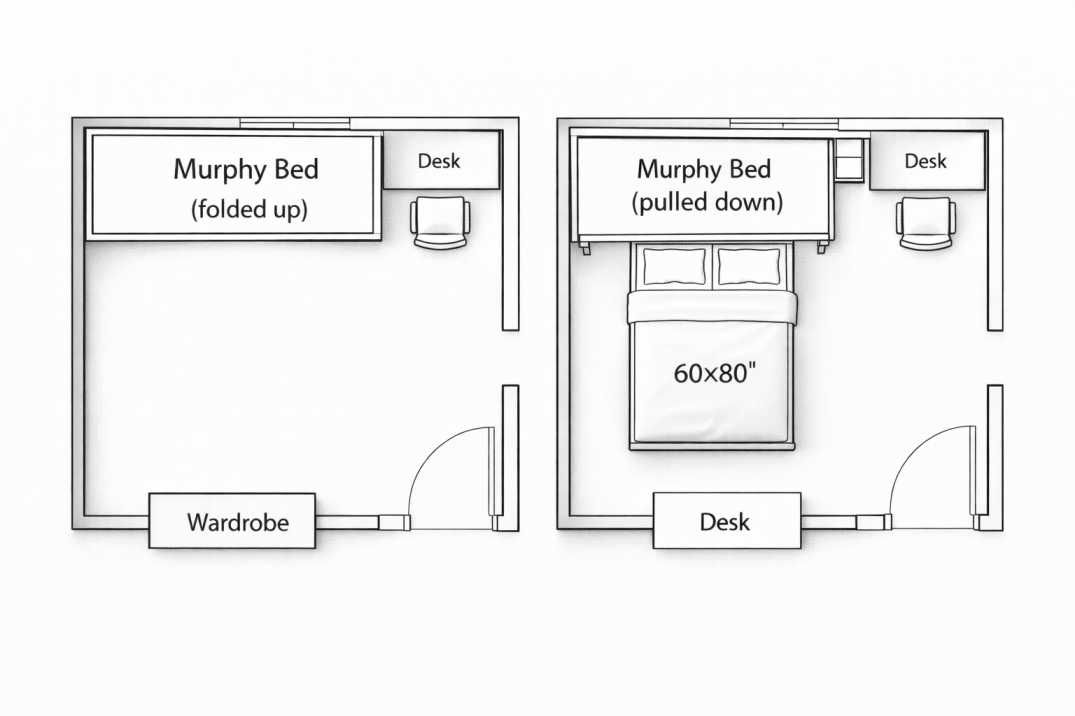
Best for: Studio rooms, guest rooms used occasionally, home office + bedroom combo.
A Murphy bed (also called a wall bed or fold-down bed) stays vertical against the wall during the day. You get a full open room to use as office, yoga space, or living area. At night, pull it down and it’s a proper bed.
- Murphy bed: 60-inch width when down, zero floor footprint when up
- Desk or sofa can sit in front of the Murphy bed frame when bed is folded
- Cost in India: ₹35,000–₹80,000 for a decent carpenter-made Murphy bed
- Pros: Full room flexibility, looks premium, great for WFH + sleep combo
- Cons: Higher cost, needs wall installation, slight setup time daily
💡 Murphy beds are gaining popularity in Indian 1BHK apartments. If you work from home and hate looking at your unmade bed during calls — this is your layout.
Layout 7 — L-Shaped Wardrobe + Bed Layout\
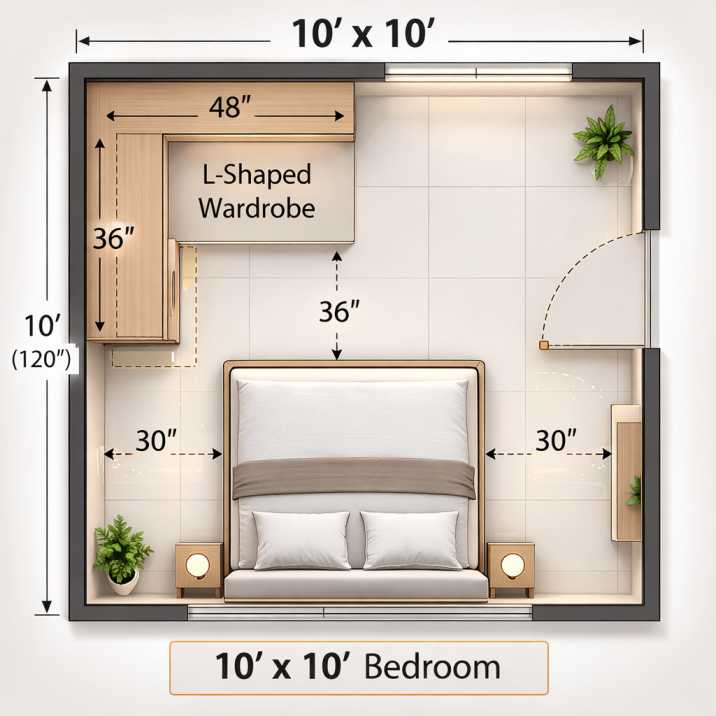
Best for: Rooms with an awkward corner, or anyone who wants wardrobe in two zones (hanging + storage separately).
An L-shaped wardrobe wraps around one corner. The bed faces the open section. This is a smart use of corner space that most people leave empty.
- L-shaped wardrobe: one arm 48 inches, other arm 36 inches, meeting at corner
- Bed: Double, positioned centrally facing the wardrobe
- Clearance: 28 inches on each side of bed, 24 inches in front of wardrobe arms
- Pros: Corners used efficiently, storage doubles, looks custom
- Cons: More expensive (custom carpentry), harder to reconfigure
Layout 8 — Bed with Under-Storage Layout
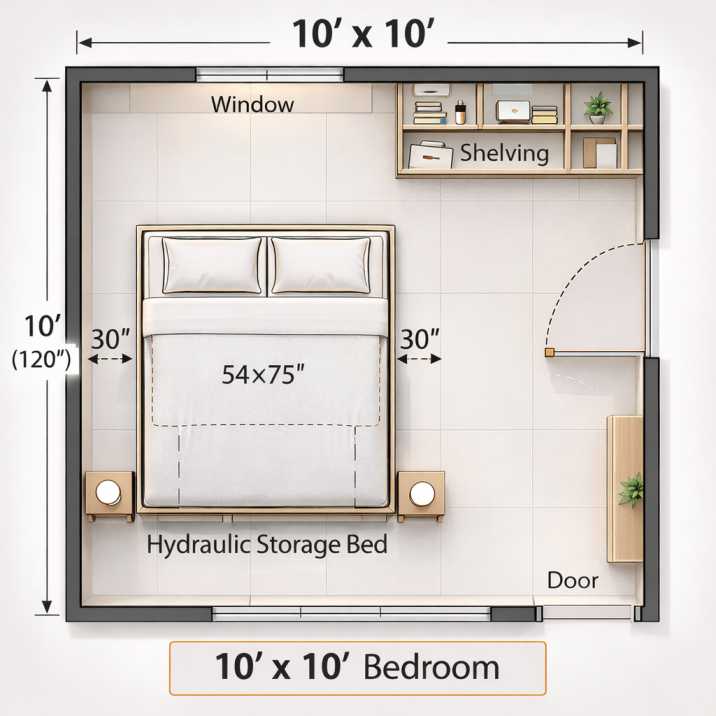
Best for: Rooms with zero wardrobe space or shared storage needs.
Instead of a separate wardrobe, the bed itself does the storage work. A hydraulic storage bed lifts up to reveal a full under-bed storage compartment — enough for bedding, seasonal clothes, and suitcases.
- Bed: Double or Queen with hydraulic storage (₹15,000–₹40,000 in India)
- No separate wardrobe needed — saves 22–24 inches of depth on one wall
- The freed wall can hold a tall shelf unit or TV unit instead
- Pros: Budget-friendly, huge storage, no carpentry needed
- Cons: Access requires lifting the mattress — less convenient for daily use items
Layout 9 — Wardrobe Opposite Bed (Classic Indian Layout)
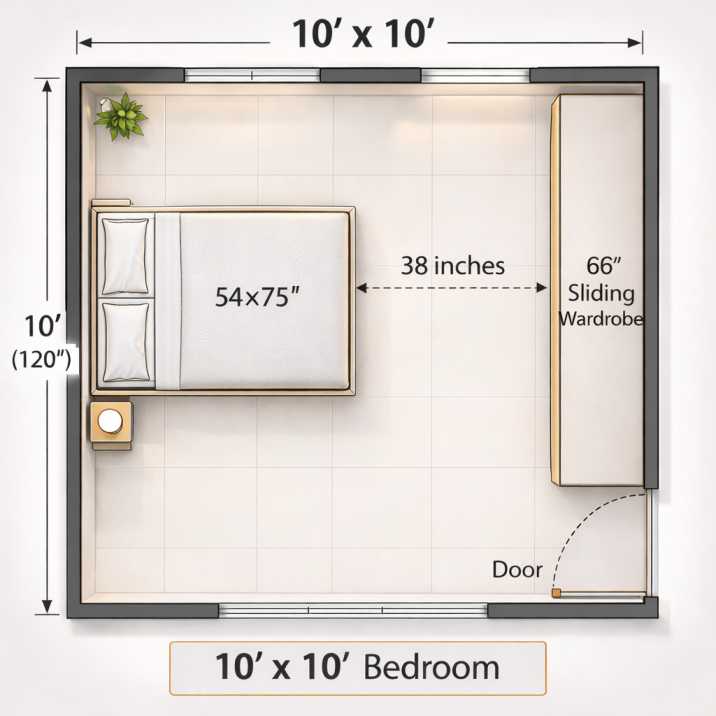
Best for: Standard master bedroom in Indian 1BHK or 2BHK apartments — the most-used layout in India.
Bed against one wall, wardrobe directly opposite. Simple, functional, and easy to execute. Most Indian bedrooms are set up this way — and there’s a reason for that. It works.
- Bed: Double or Queen, headboard against one wall
- Wardrobe: 60–72 inch sliding wardrobe directly opposite
- Clearance between bed foot and wardrobe: 36–42 inches
- TV unit option: small wall-mounted unit above the wardrobe or on the adjacent wall
- Pros: Intuitive, easy furniture shopping, no custom work needed
- Cons: Can feel predictable — but it genuinely is the most space-efficient
Layout 10 — Bed Near Window Layout (Light-First Design)
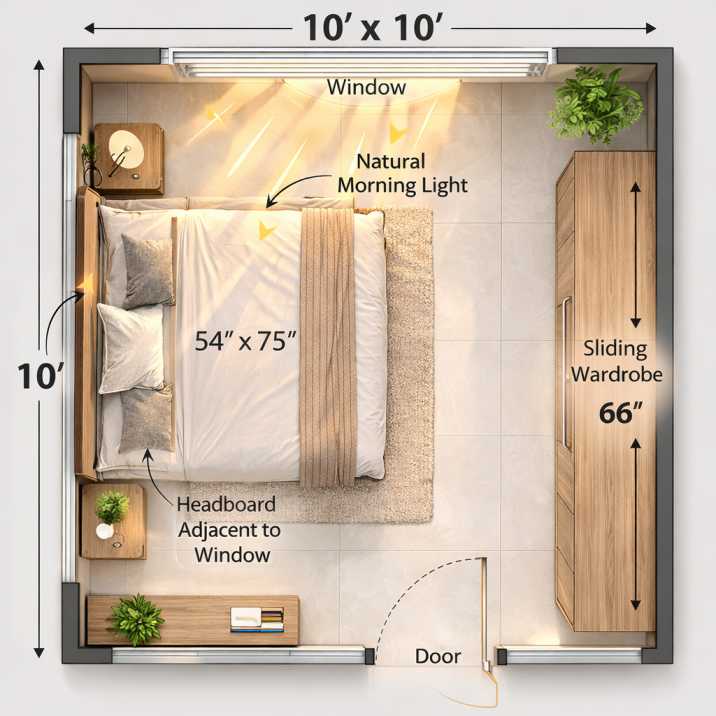
Best for: Anyone who wants to wake up naturally, values natural light, or has a great window view.
The headboard goes on the wall adjacent to the window — not under it. This means light comes in from the side in the morning, waking you naturally, without the window being blocked. The wardrobe goes on the opposite or far wall.
- Bed: Double or Queen, headboard on window-adjacent wall (perpendicular to window)
- Light enters from the side — not blocked, not directly in eyes when sleeping
- Wardrobe: opposite or far wall
- Pros: Natural light strategy, better ventilation if window is also AC-free
- Cons: Requires window placement on the right wall — measure first
Layout 11 — Compact Couple Layout (Queen Optimised)
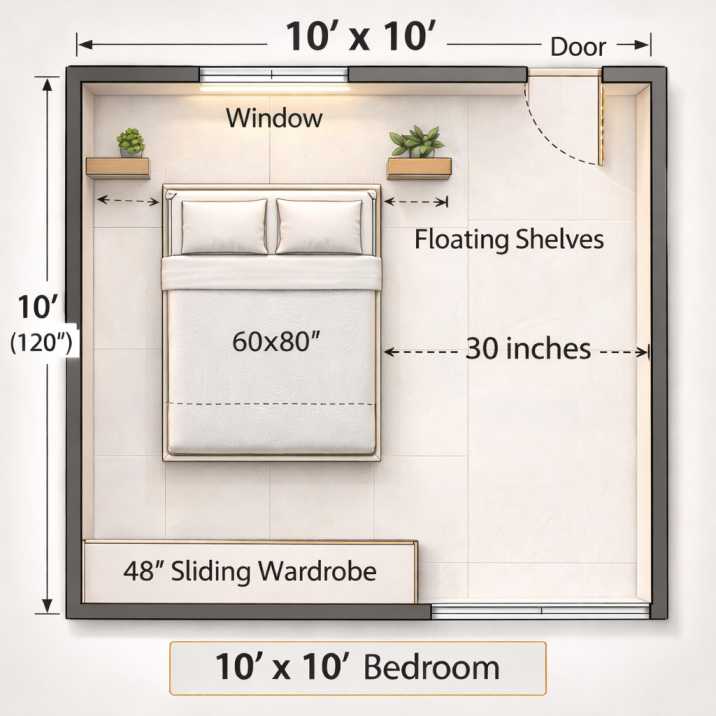
Best for: Couples who want a queen bed but are worried about space.
This layout uses every inch carefully. Queen bed centered on the main wall, no bedside tables (wall-mounted shelves instead), sliding wardrobe on the adjacent wall to free up maximum facing-wall clearance.
- Bed: Queen (60×80 inches) centered against main wall
- No bedside tables — use floating wall shelves at height instead
- Wardrobe: 48–60 inch sliding on adjacent wall (not opposite)
- Clearance: 24 inches on each side of queen bed — minimum, but workable
- Facing wall free: use for TV, mirror, or keep empty for light feel
- Pros: Queen bed without feeling cramped, facing wall becomes focal point
- Cons: Very tight side clearance — elderly or mobility-restricted users should use Layout 2 with a double bed instead
Layout 12 — Attached Bathroom / Balcony Door Special Layout
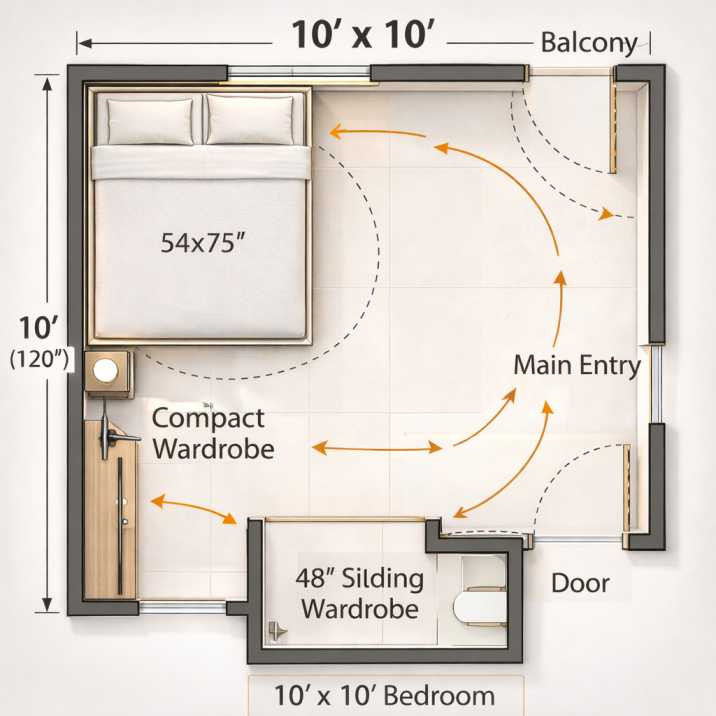
Best for: Rooms that have an attached bathroom door AND a balcony door — the most challenging 10×10 layout situation.
When your room has two doors (main entry + attached bath or balcony), the usable wall space shrinks drastically. This layout works around both door swings.
- Identify which walls have doors — these walls cannot hold large furniture
- Bed goes on the wall farthest from both doors — usually one specific corner
- Wardrobe: perpendicular to the attached bathroom door wall — not in its swing path
- Keep the central floor clear — you’ll be passing through frequently
- Floating shelves replace nightstands to save space
- Pros: Works despite two doors, logical traffic flow
- Cons: Limited furniture placement options — you’re working around fixed points
💡 Map your door swings first in this layout. Use a tape measure and mark both door arcs on the floor with tape before deciding where anything goes.
What Bed Size Actually Fits in a 10×10 Room?
This is the most common question — and the most confusing because the answer depends on what else you’re putting in the room.
Table 3: Bed Size Comparison for 10×10 Rooms
| Bed Type | Dimensions (W×L) | Approx. Remaining Floor | Recommended For |
| Single / Twin | 36×75 in | ~64 sq ft remaining | Students, guest room, kids (max floor + desk space) |
| Double | 54×75 in | ~54 sq ft remaining | Couples (best balance), single adult wanting comfort |
| Queen | 60×80 in | ~47 sq ft remaining | Couples (tight but works with sliding wardrobe) |
| King | 76×80 in | ~37 sq ft remaining | Not recommended — almost no usable clearance left |
Bed size also affects the bedsheet you choose. If you’re unsure which size works best for your bed, check this detailed guide on bedsheet sizes explained for Indian homes.
My honest recommendation for Indian homes:
- Couple in 10×10: Go double, not queen. You’ll thank yourself when you have 30 inches on each side instead of 24.
- Single adult: Single bed opens up your entire room. Add a desk, a proper wardrobe, even a small chair.
- Kids room with two children: Two singles on opposite walls beats bunk beds in most cases — safer and more personal space.
My honest recommendation for Indian homes:-
From what I’ve seen in real apartment layouts, most couples actually feel more comfortable using a double bed rather than a queen bed in a 10×10 room. The few extra inches of walking space around the bed make daily movement easier, especially in rooms that also need a wardrobe or study desk.
Also Read – How to choose the right bedsheet
10×10 Bedroom Layout for Different Users
For Couples
Your priority should be comfortable access from both sides of the bed. Aim for minimum 24 inches on each side — 27 is better. Use a double bed if your room has an attached bathroom door (queen will leave you squeezing past). Wall-mounted reading lights free up nightstand space.
For Students and WFH Professionals
The desk gets equal priority to the bed. Use a single bed in the corner, and position the desk on a perpendicular wall so the chair pulls out toward the room’s centre — not toward the bed. Good task lighting on the desk matters more than ambient lighting in this use case.
For Elderly Parents
Clearance is everything here. Minimum 30 inches on both sides of the bed — no exceptions. Avoid bunk beds, low beds, and storage beds that require lifting the mattress. A slightly raised bed (18–20 inches height) is easier to get in and out of. Keep the walking path to the bathroom completely clear with no furniture in the way.
For Kids Sharing a Room
Two single beds work better than a bunk bed for kids above age 7 — they get personal space and you don’t worry about falling. Keep the centre of the room clear for play. Use vertical wall shelves for each child’s side to avoid floor clutter.
Budget Planning for a 10×10 Bedroom in India
Being realistic here — not giving you Pinterest numbers that don’t match what things actually cost in Indian cities.
Table 4: Budget Breakdown by Range
| Budget Range | What You Get | What You Skip |
| ₹15,000–₹35,000 (Low) | Prefab wardrobe (Godrej/Hometown), basic double bed frame, curtains, paint job | Custom carpentry, modular wardrobe, quality mattress upgrade |
| ₹35,000–₹80,000 (Mid) | Modular sliding wardrobe (basic), decent bed with storage, study desk, minimal false ceiling | Premium wardrobe finishes, Murphy bed, designer lighting |
| ₹80,000–₹1,50,000 (Premium) | Custom wardrobe with internal fittings, Murphy bed or upholstered bed, false ceiling with cove lighting | None — this covers full room at good quality |
| ₹1,50,000+ (High-end) | Luxury wardrobe, imported hardware, designer furniture, AC unit, premium flooring | Nothing — this is full premium build |
Carpenter vs Modular — Quick Comparison
| Factor | Carpenter-Made | Modular (Factory) |
| Cost | Lower (₹800–₹1,200/sq ft) | Higher (₹1,200–₹2,000/sq ft) |
| Customisation | Full — any size, any shape | Limited to standard modules |
| Quality Consistency | Varies by craftsman | Consistent factory finish |
| Time | 10–20 days typically | 5–10 days installation |
| Saree/Indian clothing fit | Better — customisable sections | May need to specify custom sections |
| Best for 10×10 | L-shaped or corner layouts | Full-wall sliding wardrobe layouts |
If you’re designing a bedroom on a tight budget, you may also find this guide helpful on simple bedroom design for middle class family homes with practical low-cost ideas.
Vastu Tips for 10×10 Bedroom Layout (Optional but Practical)
Vastu is not mandatory — but in Indian homes it’s often a family consideration. Here are the commonly followed guidelines, kept practical:
- Bed direction: Head pointing South or East when sleeping is the traditional recommendation. Avoid North-facing head.
- Wardrobe: South-west corner is considered the best placement for heavy furniture including wardrobes.
- Mirror: Avoid placing a mirror directly opposite the bed (this is a common Vastu and also a practical tip — waking up to your own reflection startles some people).
- Door: Main bedroom door should ideally open inward and not directly face the bed.
- Study area: East-facing desk is considered ideal — also practically smart for morning light on the workspace.
If your layout doesn’t perfectly match Vastu — that’s okay. A well-measured, functional layout matters more than perfect directional placement in a small room.
Common 10×10 Bedroom Layout Mistakes (And How to Avoid Them)
- Buying the bed before measuring the room — always measure your exact carpet area first, not the builder plan dimensions.
- Choosing a hinged wardrobe in a room with less than 10 feet of clearance in front of it — you’ll never be able to open it fully.
- Blocking the window — a wardrobe or tall headboard in front of the only window kills natural light and ventilation. In a small room, this makes everything worse.
- Following Pinterest layouts without checking dimensions — those rooms are often 12×14 feet minimum. Don’t design a 10×10 with 12×14 inspiration.
- Forgetting the door swing — mark your door arc before placing anything. Many people realise too late that their wardrobe blocks 30% of the door’s opening.
- Putting too many statement pieces in one room — in a 10×10, one focal point (usually the bed wall) is enough. Keep the rest functional and simple.
How Your Layout Affects Sleep, Maintenance, and Durability
A good 10×10 bedroom layout isn’t just about looking nice on day one. It should still work 3–5 years from now.
- Sleep quality: A bed positioned away from direct AC airflow and not facing the main light source leads to genuinely better sleep. These are small layout decisions with real long-term impact.
- Cleaning ease: Layouts with furniture against walls (not floating in the middle) are easier to sweep and mop around. A sliding wardrobe that goes floor to ceiling collects less dust underneath.
- Furniture durability: Wardrobes placed in damp corners (especially attached-bathroom-adjacent walls) deteriorate faster. Keep wooden furniture at least 2 inches from any wall that might have moisture.
- Resale / rental value: A well-designed small bedroom can look like a much larger room in photos. If you’re renting out or planning to sell, a clear floor plan with good lighting photographs well.
Layout decisions directly affect sleep quality. According to Sleep Foundation’s bedroom environment research, factors like light exposure, airflow direction, and noise — all influenced by room layout — significantly impact how well you sleep.”
FAQs — 10×10 Bedroom Layout Questions Answered
1. Can a queen bed fit in a 10×10 room?
Yes, a queen bed (60×80 inches) fits in a 10×10 room — but it leaves approximately 24 inches of clearance on each side, which is the minimum. You’ll need to use a sliding wardrobe (not hinged), skip large bedside tables, and keep other furniture minimal. For most couples, a double bed (54×75 inches) is actually more comfortable in this room size because the extra 6 inches of clearance on each side makes a big daily difference.
2. Where should the wardrobe be placed in a 10×10 bedroom?
The most common and functional placement is directly opposite the bed. This keeps the sleeping area clean and the wardrobe accessible from a clear standing position. If your room has an attached bathroom door on the facing wall, place the wardrobe on the adjacent wall instead. Always mark door swings before finalising wardrobe placement.
3. How much walking space is needed around the bed?
Minimum 24 inches on at least one side of the bed — this is the absolute floor. If two people use the bed, aim for 24 inches on both sides. 30 inches is comfortable. Anything below 20 inches and you’ll be sideways-shuffling every morning, which gets old fast.
4. Sliding or hinged wardrobe — which is better for a 10×10 room?
Sliding wardrobe, almost always. A hinged wardrobe needs 30–36 inches of clear space in front of it to open the doors fully. In a 10×10 room, that’s often your entire walking path. Sliding doors work within the wardrobe frame — zero extra clearance needed. The only downside is you can only access half the wardrobe at a time, but that’s a small trade-off for the space saved.
5. Can two beds fit in a 10×10 room?
Yes — two single beds (36×75 inches each) placed against opposite walls leave approximately 42 inches of clear space in the centre. This works well for kids’ rooms or guest rooms. Bunk beds also work but add safety concerns for kids under 7. Avoid putting two double or queen beds in a 10×10 — the clearance becomes impractical.
6. What bed size is best for couples in a 10×10 bedroom?
A double bed (54×75 inches) is the practical answer for most Indian 10×10 rooms. It gives both people comfortable sleeping space and leaves 27 inches on each side for access. A queen bed works too if you use a sliding wardrobe and skip large bedside tables — but the daily clearance will be tighter.
7. How to fit a study desk in a 10×10 bedroom?
Use a single bed (not double) and place the desk on a wall perpendicular to the wardrobe. A compact desk of 18–24 inches depth and 36–42 inches width fits well. Make sure the chair pulls out toward the room’s centre, not toward the bed — otherwise the chair and bed foot will always be fighting for the same space.
8. How much does a 10×10 bedroom makeover cost in India?
Basic range: ₹15,000–₹35,000 covers a prefab wardrobe, decent bed, curtains, and paint. Mid-range: ₹35,000–₹80,000 gives you modular sliding wardrobe, storage bed, and proper lighting. Premium: ₹80,000–₹1,50,000 gets you full custom carpentry, false ceiling, upholstered bed, and quality hardware. Costs vary by city — Bangalore and Mumbai run 15–20% higher than Tier-2 cities.
9. Should I choose modular or carpenter wardrobe for a 10×10 room?
If you need a standard full-wall sliding wardrobe, modular is faster and more consistent in finish. If you need a corner, L-shaped, or specially sized wardrobe to fit an awkward space — a carpenter will give you better results at lower cost. For Indian clothing (sarees, heavy dupattas), specifically ask for one full-length hanging section in either case.
10. Where should the AC and fan go in a 10×10 bedroom?
AC: mount on the wall opposite the bed, in the upper corner. This allows cool air to travel across the room rather than blowing directly onto the person sleeping. Fan: centre of the ceiling. If you have a false ceiling with a beam in the centre, offset the fan slightly toward the bed side. Avoid mounting the AC directly above the headboard — it drips condensation and the cold blast directly onto your head affects sleep quality.
Conclusion
A 10×10 bedroom is not a design limitation — it’s a design challenge. And like any challenge, it rewards people who measure carefully, choose furniture that fits the actual space, and think about how they’ll live in the room day to day.
The layouts in this guide aren’t Pinterest fantasy — they’re built around real Indian apartment dimensions, real furniture sizes, and real clearance needs. Pick the one that fits your situation, measure twice, and then build it.
Start with the bed placement. Everything else follows from that one decision.
Also Read:
• 10 by 10 Room Interior Design That Actually Works (100 Sq Ft Indian Layout Guide)
• 10×10 Bedroom Layout practical tips and guide