
In This Article
-
10 by 10 Room Interior Design — Real Dimensions Explained
-
Queen vs King Bed in a 10×10 Bedroom Layout
-
Most Practical 100 Sq Ft Bedroom Layout for Indian Homes
-
10×10 Bedroom With Study Table Setup
-
Wardrobe Design & Storage Ideas for Small Bedrooms
-
Colours, Lighting & Space-Saving Tips
If you’ve ever tried setting up a 10 by 10 room interior design in an Indian home, you already know the struggle.
On paper, 100 square feet sounds decent.
But the moment you add a bed, wardrobe, mirror, and maybe a small study table, the room suddenly feels smaller than expected.
Most middle-class Indian bedrooms are around 10×10 feet — and the biggest mistake people make is focusing on decoration before layout. Expensive furniture doesn’t make a small room feel bigger. Smart placement does.
I’ve seen families invest good money into beautiful wardrobes, king-size beds, and heavy side tables, only to realise later that movement feels restricted and the space feels tight. Not because the room is small — but because the layout wasn’t planned with real dimensions.
A practical 10 by 10 room interior design isn’t about adding more things.
It’s about understanding walking space, proportions, and how furniture actually behaves inside a 100 sq ft bedroom.
In this guide, we’ll break down the layout logically — with real Indian measurements, practical setups, and mistakes most people realise only after living in the room.
Also Read – How bedsheet size and color impact small bedroom space”
Understanding 10×10 Room Size (Real Indian Dimensions)
A standard 10 by 10 room size means:
-
Length: 10 ft
-
Width: 10 ft
-
Total Area: 100 sq ft
Now subtract real furniture measurements.
Typical Indian bedroom sizes:
-
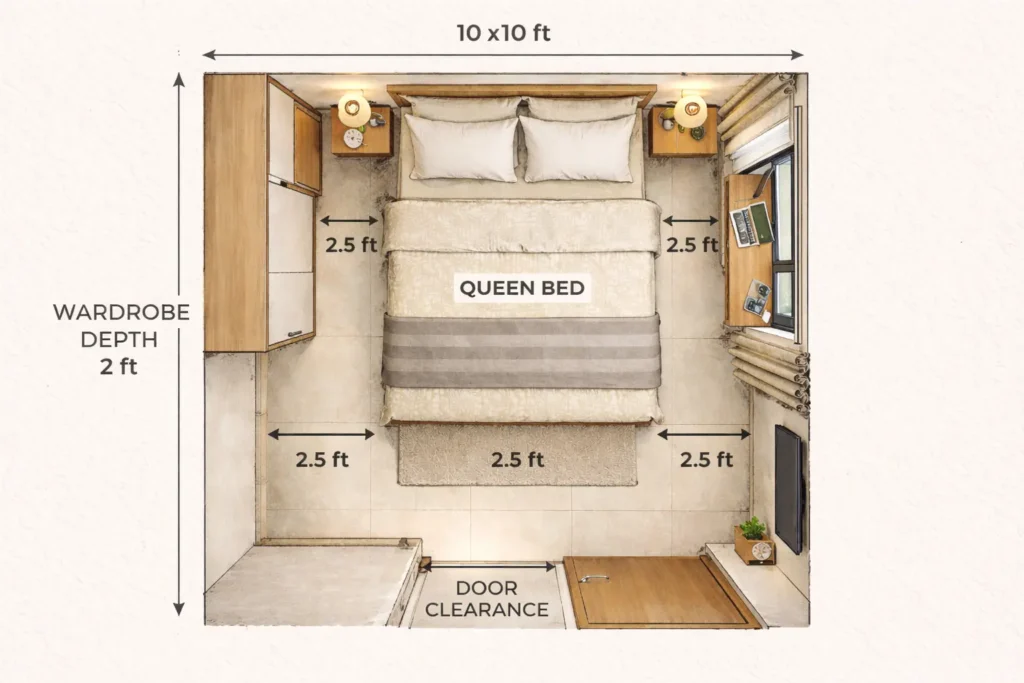
Queen Bed: 5 ft x 6.5 ft
-
King Bed: 6 ft x 6.5 ft
-
Wardrobe Depth: 2 ft
-
Door Clearance: 3 ft
-
Comfortable Walking Space: Minimum 2.5 ft
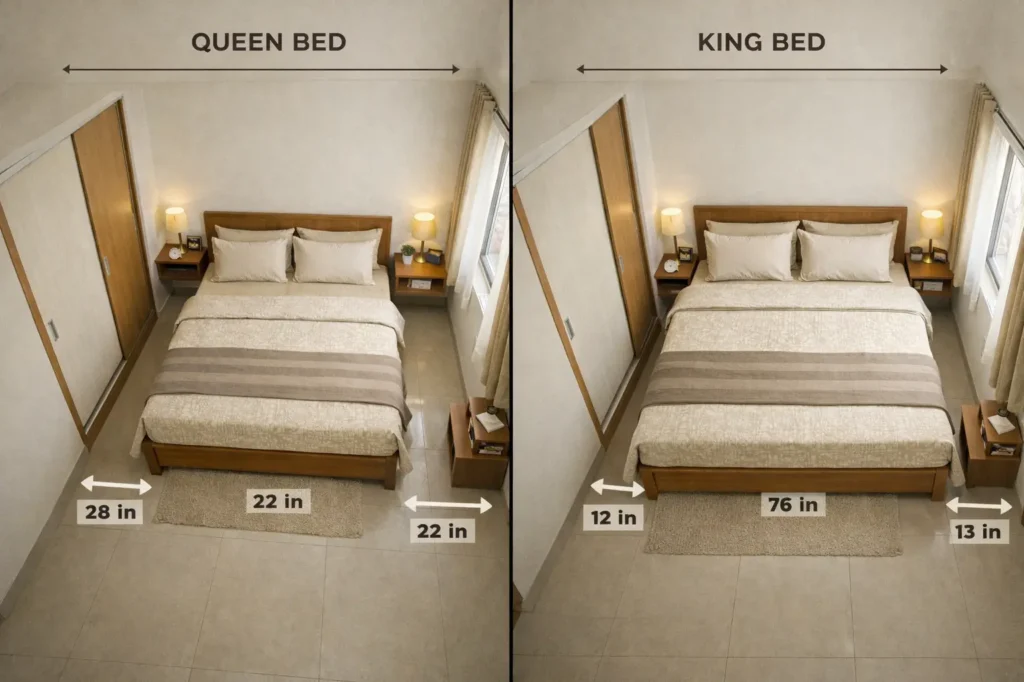
Queen Bed Calculation
10 ft – 5 ft = 5 ft remaining
Divide both sides = 2.5 ft walking space
✔ Comfortable movement.
King Bed Calculation
10 ft – 6 ft = 4 ft
Divide both sides = 2 ft clearance
❌ Feels tight in real life.
This is why bedroom layout with dimensions matters more than décor.
Also Read – Understanding Indian bedsheet sizes before buying
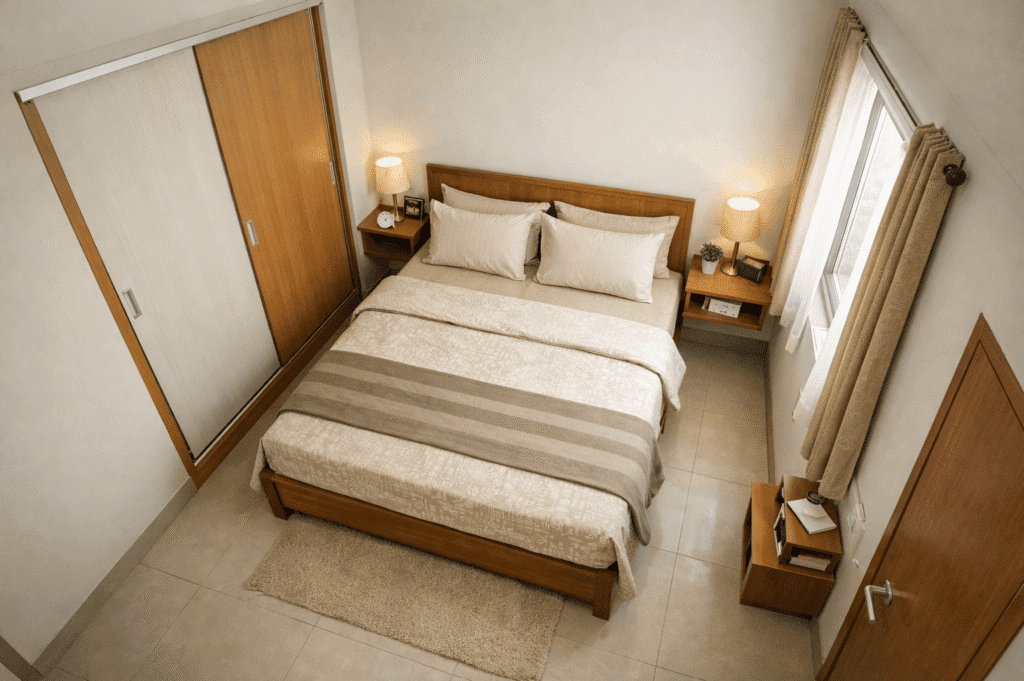
Most Practical 10×10 Bedroom Layout (Indian Couple Setup)
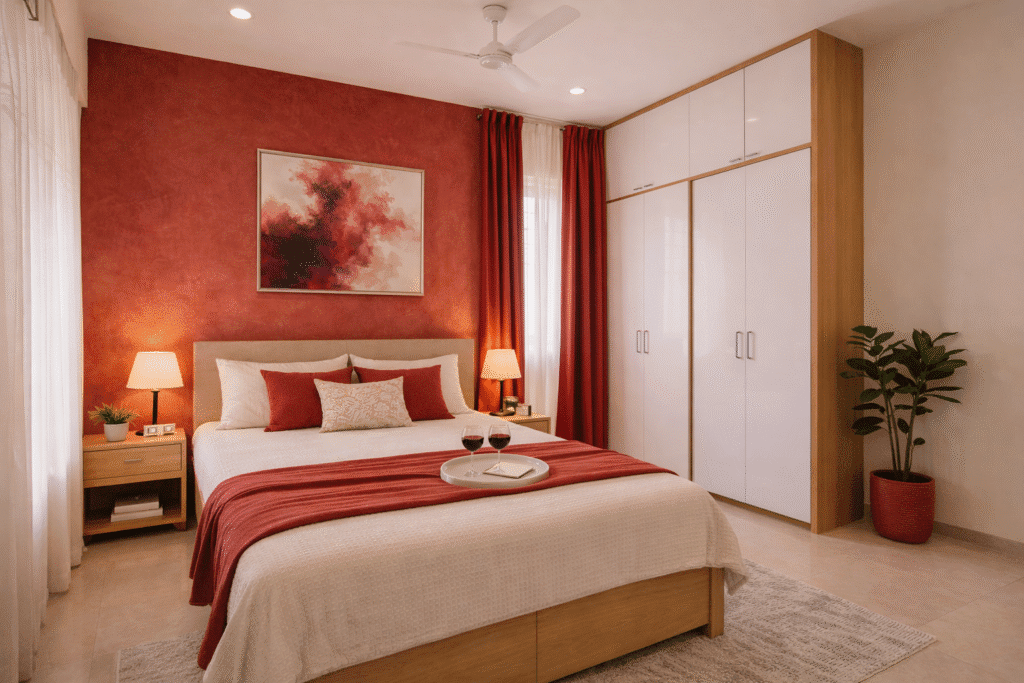
In most Indian homes, this configuration works best:
-
Bed against longest solid wall
-
Sliding wardrobe on adjacent wall
-
Window wall left open
-
Door pathway clear
Why this layout works:
-
Improves airflow
-
Allows natural light spread
-
Protects walking space
-
Reduces visual clutter
In small bedroom furniture layout, movement flow decides comfort.
If walking feels natural, the room automatically feels bigger.
Also Read – How minimalist layouts make small rooms feel bigger
Layout Variation 2 – 10×10 Bedroom With Study Table
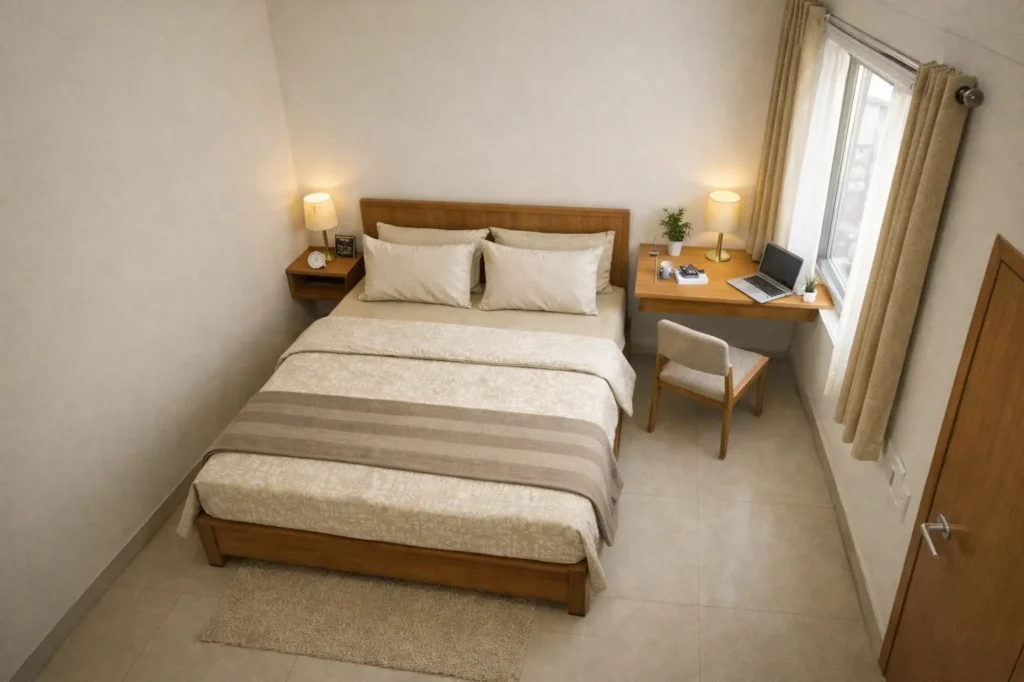
Work-from-home reality is common now.
Instead of bulky tables:
-
Use wall-mounted floating desk
-
Place desk near window
-
Avoid desk directly opposite wardrobe
Clearance Logic:
-
Bed = 5 ft
-
Wardrobe = 2 ft
-
Remaining zone must stay above 2 ft
Anything below that creates congestion.
This is where most small bedroom layouts go wrong.
Layout Variation 3 – Heavy Storage Requirement (Indian Reality)
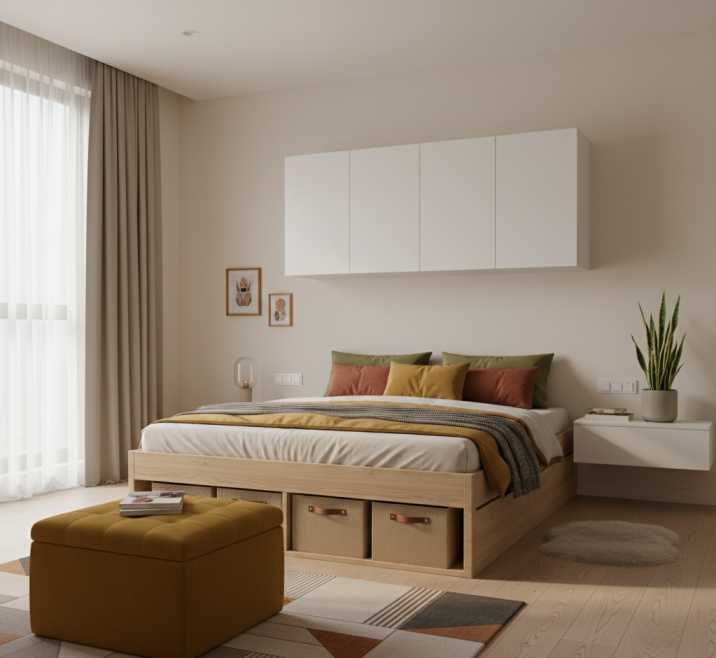
Storage pressure in Indian homes is real.
Best solution:
-
Hydraulic storage bed
-
Ceiling-height sliding wardrobe
-
Loft storage above wardrobe
Avoid extra standalone cupboards.
In a wardrobe design for 10×10 room, vertical storage is your biggest advantage.
Floor space is limited — wall height is not.
Layout Variation 4 — Single Occupant Setup (Maximum Space)
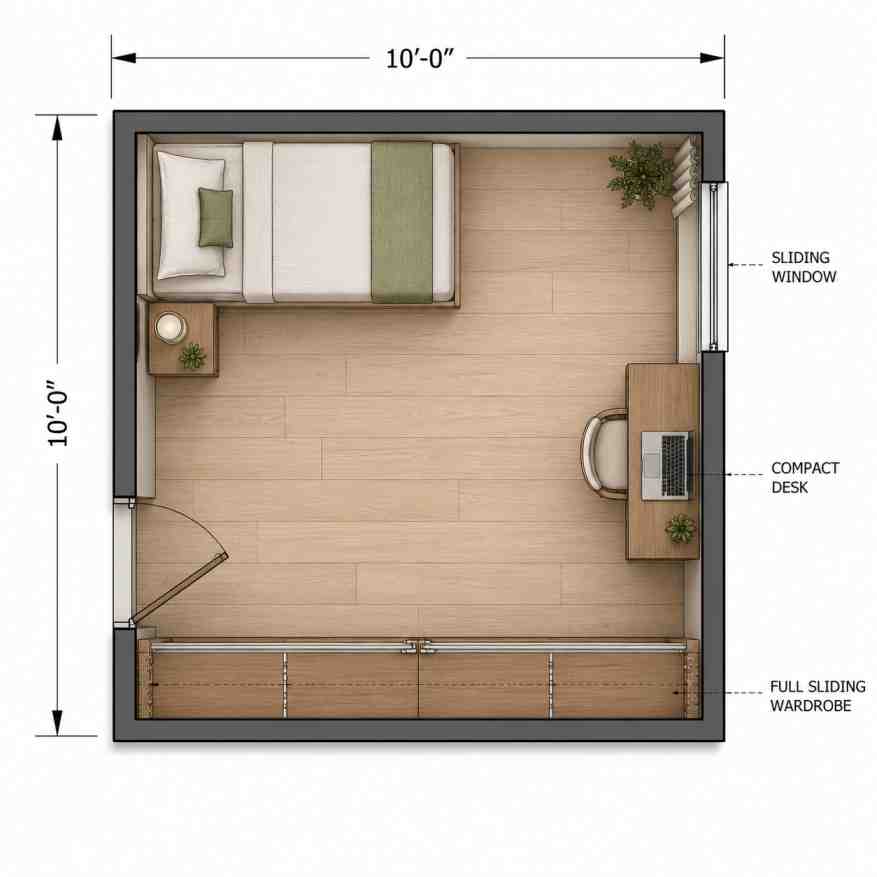
Most layout guides focus on couples. But a large number of Indian 10×10 bedrooms belong to single occupants — students, working professionals, or someone who has their own room in a family home.
A single occupant has a big advantage: the entire room can be designed around one person’s habits. This opens up possibilities that simply don’t exist when two people share the same space.
The Setup That Works Best
Place a single bed (3.5 ft × 6 ft) in the corner farthest from the door. This immediately frees up nearly 40 sq ft of open floor — enough for a proper study zone, a small exercise mat, or a reading chair.
- Single bed in far corner — two walls act as natural support
- Full-length sliding wardrobe on the opposite wall
- Desk (18–24 inch depth) on the third wall near the window
- One open wall completely free — use for shelf, pinboard, or leave empty
What You Can Add That Couples Cannot
- A proper study desk with chair — without it eating into anyone else’s space
- A small bookshelf or display unit on the free wall
- An exercise mat zone in the open floor area
- A reading chair or bean bag in the corner opposite the bed
The single occupant 10 by 10 room interior design works best when you resist the urge to fill the open space with unnecessary furniture. The empty floor is not wasted space — it is breathing room.
Queen vs King Bed in 100 Sq Ft Bedroom
| Bed Type | Width | Walking Space Left | Practical? |
|---|---|---|---|
| Queen | 5 ft | 2.5 ft | ✅ Ideal |
| King | 6 ft | 2 ft | ❌ Tight |
Technically a king bed fits.
Functionally, queen works better.
In a very small bedroom layout, proportion always beats appearance.
Bedroom Furniture Placement Science
Most 10×10 bedrooms fail because of furniture overload.
Avoid:
-
Two heavy side tables
-
Large dressing units
-
Extra chairs
-
Thick padded headboards
Choose:
-
Floating side shelves
-
Wall-mounted mirrors
-
Compact lighting
-
Lightweight curtains
Bedroom furniture placement should protect the focal point — the bed — without blocking movement.
Visual weight matters.
If everything sits heavily on the floor, the room feels suffocated.
Dressing Table in a 10×10 Room — Fit Hogi Ya Nahi?
This is one of the most common questions in 10 by 10 room interior design, especially for Indian households where a dressing table is considered essential in a bedroom.
Honest answer: a full dressing table with a large mirror and separate stool is difficult to fit in a 10×10 room without sacrificing clearance. But there are smarter alternatives that serve the same purpose without eating into your walking space.
Option 1 — Wall-Mounted Mirror with Narrow Shelf
- A 24-inch wide wall mirror mounted at head height
- A narrow floating shelf below it (12-inch depth) for essentials
- Foldable stool that slides under the shelf when not in use
- Space used: zero floor space, only 12 inches of wall depth
Option 2 — Wardrobe with Built-in Mirror + Vanity Section
- Many sliding wardrobes come with a full-length mirror panel
- Ask the carpenter to add a small pull-out tray inside the wardrobe for makeup/grooming items
- This combines three functions — storage, mirror, vanity — in the same footprint
- Best option for 10×10 if you already have a sliding wardrobe planned
Option 3 — Compact Dressing Unit (Only If Room Allows)
- Minimum size: 30 inches wide × 18 inches deep
- Place on the same wall as the bed — not opposite or adjacent to the wardrobe
- Use a mirror that folds flat when not in use
- Only viable if you are using a single bed — not recommended with a queen or double bed in 10×10
If you try to fit a standard full-size dressing table (usually 42 inches wide × 20 inches deep) into a 10×10 room that already has a double bed and wardrobe — the walking clearance drops below 18 inches somewhere. That causes daily friction every time you move through the room.
Sliding vs Hinged Wardrobe — What Actually Works?
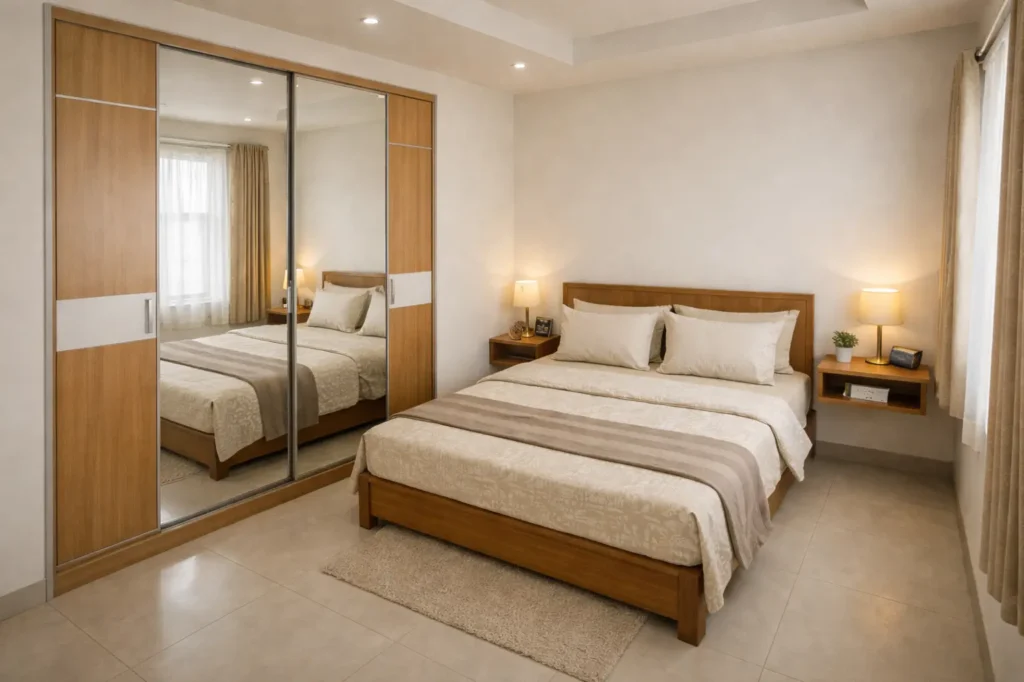
Hinged wardrobes need around 1.5 ft swing space.
In a 100 sq ft bedroom layout, that’s expensive real estate.
Sliding wardrobe advantages:
-
Saves movement space
-
Cleaner look
-
Less obstruction
Depth rule:
👉 Minimum wardrobe depth = 2 ft.
Full mirror wardrobes can visually enlarge space — but too much mirror can make the room feel like a hotel.
Balance is key.
Also Read – Budget-friendly small bedroom decor tips
AC and Fan Placement in a 10×10 Bedroom — What Actually Works
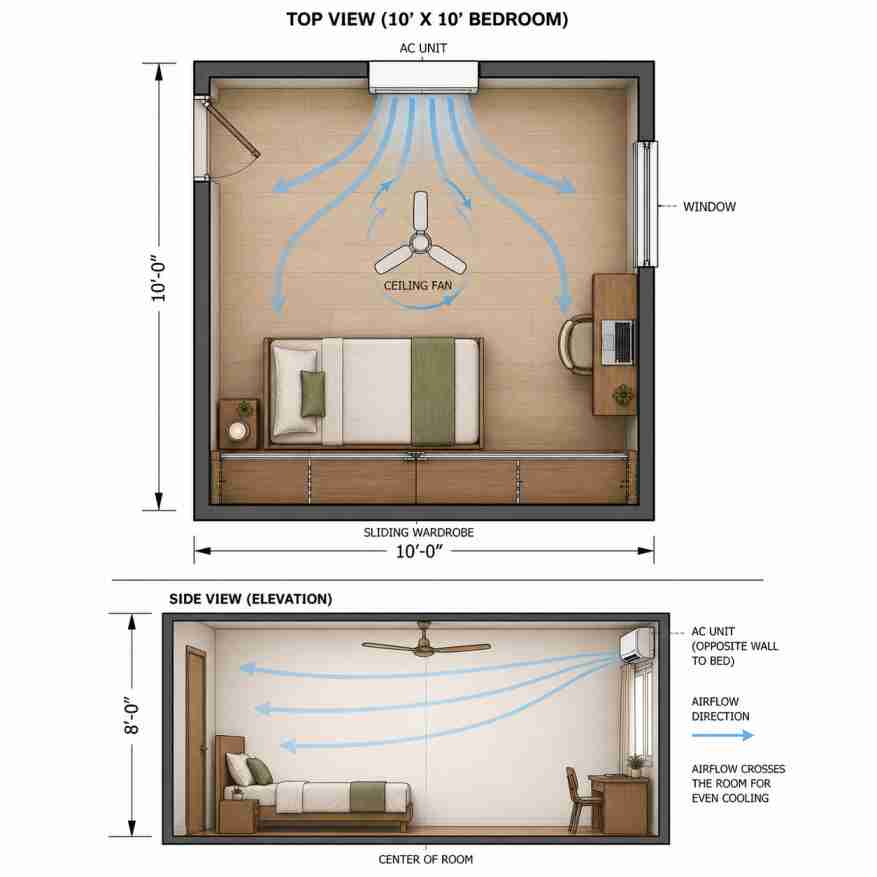
AC and fan placement is one of those decisions most people make based on where the electrician suggests — not based on how the room will actually feel. In a small 10 by 10 room interior design, the wrong placement makes the room uncomfortable regardless of how well everything else is planned.
AC Placement Rules
The single most important rule: the AC should never blow directly onto the bed.
- Mount the AC on the wall opposite the bed, in the upper corner
- This lets cool air travel across the full length of the room before it reaches you
- The airflow hits the far wall and circulates naturally — no direct cold blast on the body
- Keep at least 6 inches of space above the AC unit from the ceiling for proper airflow
Common mistake Indian homes make: mounting the AC directly above the headboard because that wall is easiest to route the pipe through. The result — neck pain, sore throat, and poor sleep quality over time.
Fan Placement Rules
- Ceiling fan should be centered — directly above the middle of the room
- If you have a false ceiling with a beam, offset the fan slightly toward the bed
- Avoid mounting the fan directly above the wardrobe — it circulates dead air from the corner
- For a 10×10 room, a 48-inch fan (4-foot blade span) is sufficient — a 56-inch fan is oversized and creates too much downwash in a small room
Table: AC vs Fan — Quick Placement Guide
| Factor | AC Placement | Fan Placement |
| Best wall | Opposite the bed | Ceiling center |
| Height | Upper corner, 7–8 ft from floor | Minimum 8 ft from floor clearance |
| Avoid | Above headboard | Above wardrobe corner |
| Size for 10×10 | 1 ton is sufficient | 48-inch blade span |
| Common mistake | Direct airflow on sleeping person | Too-large fan, too-low mounting |
Color & Lighting Psychology for Small Bedrooms
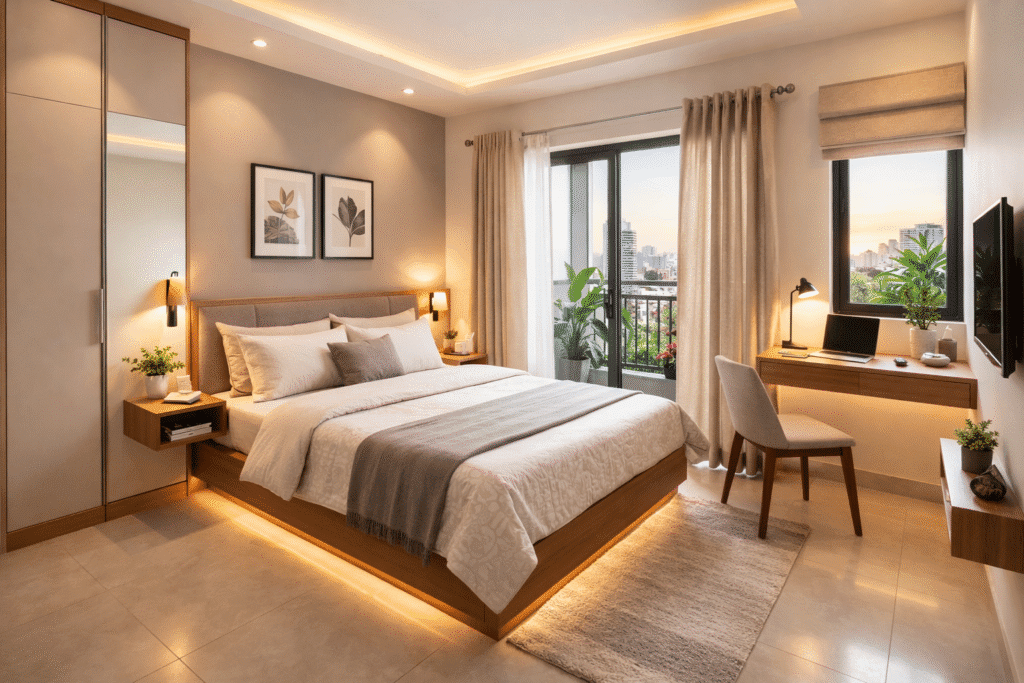
Light colours reflect light.
Dark colours absorb it.
Best shades for small bedroom layout ideas:
-
Warm white
-
Light beige
-
Soft grey
-
Pastel green
According to research in environmental psychology, lighter tones create a sense of openness and calm in confined spaces. Even resources like Verywell Mind explain how color influences perception and mood.
https://www.verywellmind.com/color-psychology-2795824
Lighting strategy:
-
Warm LED (2700–3000K)
-
Bedside wall lamps
-
Avoid harsh white tube lights
Lighting balance changes how large a room feels.
Lighter tones make confined spaces feel calmer and more open.
Lighting Strategy:
-
Warm LED (2700K–3000K)
-
Bedside wall lamps
-
Avoid harsh tube lights
- Also Read – Light coloured bedsheets that make small rooms look bigger
False Ceiling for a 10×10 Bedroom — Should You Get One?
False ceiling comes up in almost every Indian bedroom interior discussion. For a 10×10 room, the answer is: it depends on your ceiling height and what you want to achieve.
When False Ceiling Makes Sense
- Your original ceiling is above 10 feet — a false ceiling at 9 feet brings it to a better proportion
- You want cove lighting (indirect LED strips) — this genuinely makes a small room feel larger
- You want to hide AC pipes, electrical wiring, or uneven plaster
- Your budget allows ₹15,000–₹25,000 for a simple POP false ceiling in 10×10
When False Ceiling Is a Bad Idea
- Your ceiling is already at 9 feet or below — dropping it further makes the room feel cramped
- You have a ceiling fan — false ceiling often forces the fan too low (minimum 7.5 feet clearance needed)
- Budget is tight — spend that ₹15,000–₹25,000 on a better wardrobe or storage bed instead
Table: False Ceiling Decision Guide for 10×10 Room
| Ceiling Height | Recommendation | Why |
| Below 9 ft | Skip false ceiling | Room will feel lower and smaller |
| 9 ft – 10 ft | Optional — cove lighting only | Full drop not recommended, cove strip on perimeter works |
| 10 ft – 12 ft | Yes — good candidate | Drop to 9 ft improves proportion, space for cove lighting |
| Above 12 ft | Recommended | High ceiling feels impersonal in bedroom, false ceiling adds cosiness |
💡 PRO TIP: Cove lighting (LED strip hidden in a perimeter tray) is the single most effective visual trick for small bedrooms. It adds warmth, hides wiring, and makes the ceiling look higher — not lower. Even in a 9 ft ceiling room, a 4-inch perimeter tray with warm LED strip costs under ₹8,000 and transforms how the room feels.
Budget Framework for 10×10 Bedroom (India 2026)
₹25K–₹35K – Low Budget Refresh
-
Wall repaint
-
Lighting upgrade
-
Storage reorganisation
-
New curtains
₹40K–₹60K – Smart Upgrade
-
Storage bed
-
Sliding wardrobe
-
Layered lighting
₹60K–₹90K – Full Functional Upgrade
-
Modular wardrobe
-
Accent wall
-
Soft furnishing refresh
In middle-class homes, function should always come before decoration.
Common 10×10 Bedroom Layout Mistakes
-
Choosing king bed without calculation
-
Hinged wardrobe in tight space
-
Blocking window airflow
-
Heavy dark curtains
-
Too many décor items
-
Wardrobe directly opposite door path
Small room design is about subtraction — not addition.
Vastu Tips for 10×10 Bedroom — Practical Points Only
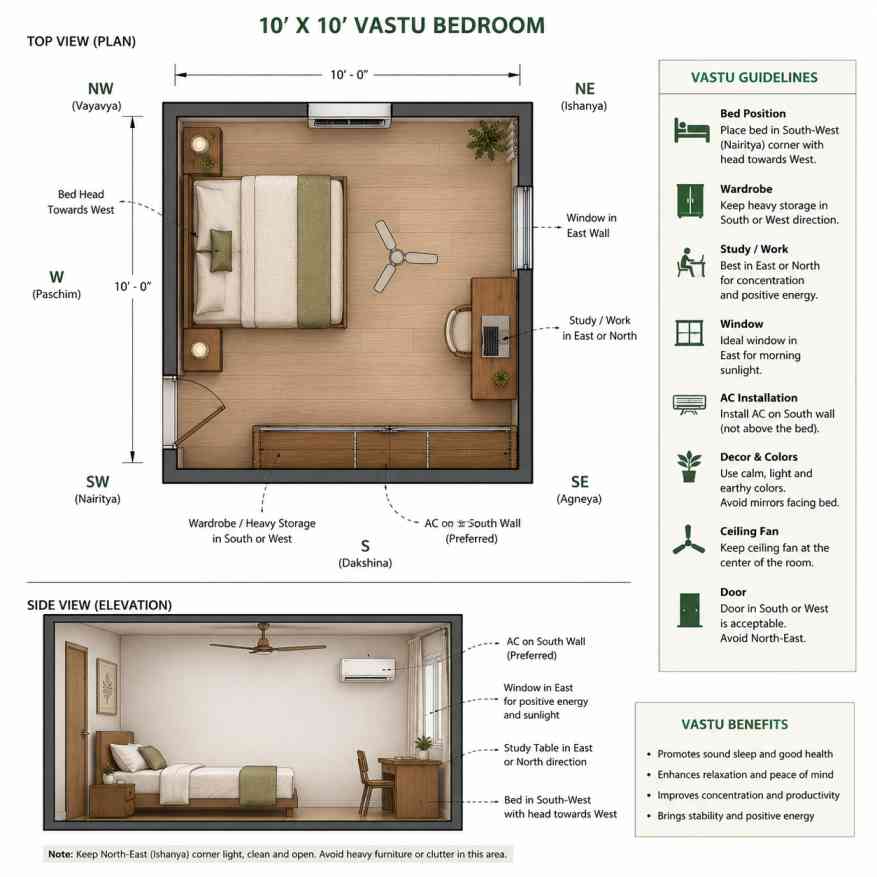
Vastu is a consideration in many Indian households — especially when elders are involved in home decisions. These are the most commonly followed vastu guidelines for a bedroom, kept practical and without conflicting with your layout logic.
These are optional — but if your family follows vastu, here is what matters most in a 10 by 10 room interior design:
- Bed direction: Sleep with head pointing South or East. Avoid North-facing head — this is the most commonly cited vastu guideline for bedrooms across India.
- Wardrobe placement: South-west corner is considered best for heavy furniture. In a 10×10 layout, this is usually the corner farthest from the door — which also happens to be the most practical placement.
- Mirror: Don’t place a mirror directly opposite the bed. This is both a vastu guideline and a practical one — waking up to your own reflection is startling for many people.
- Door: Bedroom door should ideally not open directly facing the bed. If it does, a curtain or sheer panel across the doorway is a common solution.
- AC direction: Avoid sleeping with your head directly under an AC unit — this aligns with both vastu and practical comfort logic.
- Electronics: Keep TV and phones away from the bed side in vastu — again, this also aligns with sleep hygiene recommendations.
If your layout doesn’t perfectly follow every vastu guideline — prioritise function first. A well-planned room you can move around comfortably in will always be better than a vastu-perfect layout where you bump into the wardrobe every morning.
How Proper Layout Improves Daily Life
A well-planned 10 by 10 room interior design improves:
-
Sleep quality
-
Morning routine speed
-
Cleaning efficiency
-
Storage access
-
Mental clarity
Bad layout creates daily friction.
Good layout reduces stress.
10×10 Bedroom Layout for Elderly Parents — What Changes
When a 10×10 bedroom is being designed for elderly parents or grandparents, the priorities shift completely. It is no longer about aesthetics or storage maximisation — it is about safety, accessibility, and ease of movement at every hour of the day and night.
I have seen many Indian families make the mistake of designing an elderly person’s bedroom the same way they would design their own — and then realising six months later that the layout creates daily difficulties.
What to Prioritise
- Clearance first: Minimum 30 inches on both sides of the bed — no compromise. Getting in and out of bed at night in low light needs generous space.
- Bed height: 18–20 inches from floor to mattress top. Too low means difficulty standing up. Too high means difficulty sitting down safely.
- Avoid storage beds: Hydraulic beds require lifting the mattress — not suitable for elderly users with knee or back issues.
- Clear path to bathroom: The walking path from bed to bathroom door must have zero obstacles. No chair legs, no side table corners, nothing.
- Light switch placement: Ensure a light switch is reachable from the bed without getting up — or use a bedside plug-in lamp.
What to Avoid
- Bunk beds or loft beds — obvious safety risk
- Low beds (below 16 inches) — difficult to stand from
- Rugs or mats near the bed — slip hazard especially at night
- Furniture with sharp corners at knee or hip height
- Overcrowded layout where any night-time movement requires careful navigation
In a 10 by 10 room interior design for elderly use, a double bed with 30-inch clearance on both sides, a simple sliding wardrobe, and a completely clear path to the door is the most functional and safe setup.
Quick Blueprint for a Perfect 10×10 Bedroom
-
Measure real dimensions
-
Choose queen bed
-
Maintain 2.5 ft walking clearance
-
Use sliding wardrobe
-
Stick to light colour palette
-
Use vertical storage
-
Avoid bulky furniture
Design with math.
Decorate later.
Frequently Asked Questions
What is the best layout for a 10×10 bedroom?
Place a queen bed against the longest wall, maintain 2.5–3 feet walking clearance, and install a sliding wardrobe to optimize space.
Can a king bed fit in a 10×10 room?
Yes, but it reduces walking space to around 2 feet, making movement uncomfortable.
How much walking space is needed around the bed?
Minimum 2.5 feet for comfortable movement.
What wardrobe type is best for 10×10 bedroom?
Sliding wardrobe with 2 ft depth is ideal.
Which color makes a 100 sq ft bedroom look bigger?
Warm white, light beige, or soft grey reflect more light and visually expand the space.
Can a dressing table fit in a 10×10 bedroom?
A full-size dressing table (42 inches wide) is difficult to fit in a 10×10 room that already has a double bed and wardrobe — it removes too much clearance. Better alternatives: a wall-mounted mirror with a narrow floating shelf, or a wardrobe with a built-in mirror panel and internal vanity tray. If you insist on a standalone dressing unit, use one only with a single bed setup.
Should I get a false ceiling in a 10×10 bedroom?
Only if your ceiling is 10 feet or above. At 9 feet or below, a false ceiling makes the room feel more cramped. If you have enough height, a perimeter cove lighting tray (4 inches deep) with warm LED strip is the best false ceiling option for a small bedroom — it adds warmth without dropping the ceiling significantly.
Where should the AC be placed in a 10×10 bedroom?
Mount the AC on the wall opposite the bed, in the upper corner. This allows airflow to travel across the room naturally rather than blowing directly onto you while you sleep. Avoid mounting the AC directly above the headboard — it causes direct cold airflow on the head and neck, leading to poor sleep quality over time.
What is the best 10×10 bedroom layout for elderly parents?
Prioritise clearance over storage. Minimum 30 inches on both sides of the bed, a bed height of 18–20 inches from floor to mattress, and a completely clear path from the bed to the bathroom door. Avoid storage beds (require mattress lifting), rugs near the bed (slip hazard), and any furniture with sharp corners in the walking path.
Is 10×10 too small for a master bedroom in India?
Not at all. Most Indian 1BHK and 2BHK apartments have bedrooms between 100 and 130 sq ft. A 10×10 room is 100 sq ft — which is fully functional for a couple when planned correctly with a double bed, sliding wardrobe, and proper clearance. The key is choosing furniture proportional to the room, not furniture you saw in a showroom designed for a 12×14 space.
Final Thoughts
A smart 10 by 10 room interior design is not about expensive furniture.
It’s about understanding geometry.
When you calculate first and decorate later, even a 100 sq ft bedroom can feel open and functional.
Design with logic.
Place furniture with intention.
Live with comfort.
- Also Read – Simple bedroom design ideas for middle class Indian homes
- Also Read our super details practical Guide – 10×10 Bedroom Layout: 12 Smart Floor Plans for a 100 Sq Ft Room